Pawdit presents manufacturer-declared facts and attributes every note to its published source. We do not rate, grade or rank products. This assessment is generated by an algorithmic methodology based on published sources. It is not a guarantee of product quality or safety. Always consult your veterinarian.
21 ingredients (broken into components where relevant) · tap any for its research notes
What do these mean? ▾
Beneficial. Linked to benefits in published research. Tiers show evidence strength.
Restricted or banned. Restricted or banned by a regulator in at least one country.
Under research review. Being studied or re-evaluated by researchers or regulators.
Contextual. Not flagged, but there is a note worth reading.
Standard. Everyday components like vitamins and minerals.
Not yet classified. Not in our dictionary yet. Always still listed.
Counts include what's inside compound entries like vitamin premixes, so they can add up to more than the label's ingredient count.
1Brewers RiceRice / brewer's rice▾
● Contextual noteA highly digestible carbohydrate. Brewer's rice is a milling by-product but still provides nutritional value.Sources: NRC 2006
2Whole Grain CornCorn / corn gluten meal▾
● Contextual noteA digestible carbohydrate and protein source for most dogs. Commonly characterised as filler in consumer discussions, but veterinary nutrition research supports its nutritional value.Sources: AAFCO 2024 · NRC 2006
3Chicken By-Product MealMeat with species named (partial disclosure)
Show all 21 ingredients ▾
9Chicken Liver FlavorNamed organ meats▾
● Beneficial (well-established)Organ meat from a named animal species, with both the species and the organ identified. Published nutrition references describe named organ meats (e.g. chicken liver, beef heart) as nutrient-dense, naturally rich in vitamins A and B12, iron, copper, and folate. Organ words without a species (e.g. "liver" alone) are classified under Organ meats (unspecified).Sources: NRC 2006 · Nutritional composition data
10Calcium SulfateCalcium salts▾
● Standard ingredientA standard added calcium (mineral) supplement.Sources: NRC 2006
Nutrient analysis
dry matter, the manufacturer's basis · compared to AAFCO adult dog maintenance minimums
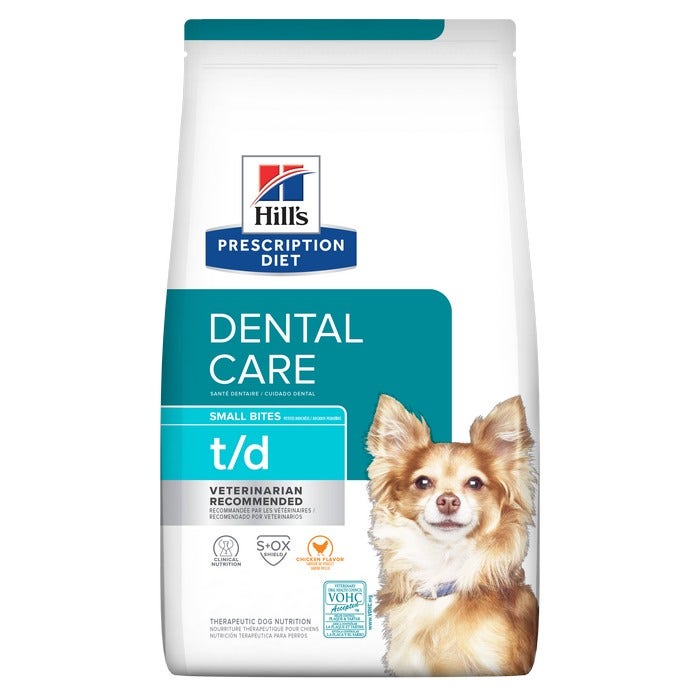
✓Feeding trials substantiate that this product meets AAFCO nutrient profiles (Adult)"Animal feeding tests using AAFCO procedures substantiate that Hill's Prescription Diet t/d Small Bites Chicken Flavor provides complete and balanced nutrition for maintenance of adult dogs." (brand statement)
Protein18.3%AAFCO min 18% DM
Fat16.5%AAFCO min 5.5% DM
Fibre10.8%no AAFCO reference
3,468 kcal/kg≈ 1,451 kJ / 100g energy densityBrand states 3,468 kcal/kg
This manufacturer publishes its analysis on a dry-matter basis (with moisture removed), so the values above are shown on that basis and moisture is not stated. AAFCO minimums are also dry-matter figures, so they compare directly; the comparison is shown for context only. Consult your vet for diet decisions.
Brand transparency
Hill's Prescription Diet · what the manufacturer discloses, not a rating
Part of Colgate-Palmolive (Hill's Pet Nutrition) · 3 brands on Pawdit
Recall historyrecall recorded2019: Included in excess Vitamin D canned dog food recall. Multiple products affected.
AS5812 accreditationAustralia's voluntary pet food manufacturing standardnot confirmed
PFIAA membershipPet Food Industry Association of Australiaconfirmed
Quality certificationsconfirmedAAFCO · FDA cGMP
Parent companydisclosedColgate-Palmolive (Hill's Pet Nutrition)
A factual disclosure checklist from public records and the brand's own statements. Items we haven't verified show as not confirmed: a data gap, not a judgment. Are you Hill's Prescription Diet? Claim your brand to confirm or correct this record.
Customer reviews
4.4
66 reviews · aggregated from retailer listings across multiple sources
Where to buy
confirm prices and explore sizes on the retailer's site
● Contextual noteA meat ingredient where the animal species is named but disclosure is partial: by-products from a named species (e.g. chicken by-product meal; also labelled "co-products", the industry's newer term), or a generic meat term with the species named in brackets (e.g. meat meal (beef and/or lamb)). An "and/or" list means the exact mix may vary between batches; where a percentage is shown (e.g. "chicken 27%"), only that minimum is guaranteed to come from that species. Named species are checked against your pet's allergy profile. By-product and co-product terms do not specify which parts are used. More transparent than fully unnamed meat terms; named whole meats, meals, and organ meats provide the strongest traceability.Sources: AAFCO ingredient definitions · EU Regulation 767/2009
● Under research reviewA plant-derived insoluble fibre. Provides bulk but limited nutritional value. Acceptable in small amounts; when present as a primary fibre source (top 10 ingredients), it may indicate a high proportion of nutritionally inert filler.Sources: NRC 2006 Nutrient Requirements · Nutritional composition data
5Pork Fat▾
● Standard ingredientA named animal fat source providing energy and essential fatty acids.Sources: AAFCO ingredient definitions
6Soybean Mill RunSoy / soybean meal▾
● Contextual noteA plant-based protein source. Contains phytoestrogens (isoflavones). A common allergen in some pets.Sources: NRC 2006 · AAFCO 2024
7Lactic Acid▾
● Standard ingredientA naturally occurring organic acid used as a preservative or pH regulator.Sources: AAFCO ingredient definitions
8Soybean Oil▾
● Contextual noteA plant-derived oil providing omega-6 fatty acids. Derived from soybeans, which are a common allergen in some pets. Relevant for allergy-prone pets.Sources: NRC 2006 · AAFCO ingredient definitions
11Potassium ChloridePotassium salts
▾
● Standard ingredientA standard added potassium (mineral) supplement.Sources: NRC 2006
12L-Lysine▾
● Standard ingredientAn essential amino acid added as a standard supplement.Sources: NRC 2006
13Iodized SaltSalt▾
● Contextual noteAn essential mineral present in all pet food. Flag only when appearing high on the ingredient list.Sources: NRC 2006
14Choline Chloride▾
● Standard ingredientCholine chloride: a standard added nutrient for normal cell and nerve function.Sources: NRC 2006
● Standard ingredientA generic term for a vitamin premix. Where the label lists the specific vitamins in brackets, each is shown and classified below; otherwise the individual vitamins are not disclosed.Sources: AAFCO ingredient definitions
The label breaks this entry into components, each classified on its own:
16TaurineTaurine (supplemental)▾
● Beneficial (well-established)Taurine supplementation is increasingly common in dog food, particularly for breeds associated with DCM susceptibility.Sources: Pion et al. 1987 · NRC 2006 · Freeman et al. 2018Position on the ingredient list suggests a small inclusion level.
● Standard ingredientA generic term for a mineral premix. Where the label lists the specific mineral compounds in brackets, each is shown and classified below; otherwise the individual minerals are not disclosed. European-style labels declare added trace minerals as numbered additives with doses (e.g. "E4 (copper): 10 mg").Sources: AAFCO ingredient definitions
The label breaks this entry into components, each classified on its own:
18Mixed Tocopherols for freshnessMixed tocopherols (natural preservative)▾
● Beneficial (emerging)This product uses mixed tocopherols (natural vitamin E) as a preservative, which is an alternative to synthetic preservation systems.Sources: NRC 2006Position on the ingredient list suggests a small inclusion level.
19Phosphoric AcidPhosphate salts (misc.)▾
● Standard ingredientPhosphate salts used as mineral nutrient sources and processing aids (texture, palatant carriers), and phosphoric acid as an acidifier. Distinct from the condensed phosphates under research review (sodium tripolyphosphate, sodium hexametaphosphate), which are classified separately.Sources: AAFCO ingredient definitions · EU Regulation 767/2009
20Beta-Carotene▾
● Beneficial (emerging)A provitamin A carotenoid and antioxidant. Some studies have explored its role in immune function and skin health in dogs. Note: cats cannot convert beta-carotene to vitamin A.Sources: Chew et al. 2000 (Journal of Nutrition)Position on the ingredient list suggests a small inclusion level.
21Natural FlavorsNatural flavours▾
● Contextual noteA broad AAFCO-defined category that may contain multiple unspecified compounds. Relevant for allergy-prone pets since potential allergens may not be individually listed.Sources: AAFCO 2024