Pawdit presents manufacturer-declared facts and attributes every note to its published source. We do not rate, grade or rank products. This assessment is generated by an algorithmic methodology based on published sources. It is not a guarantee of product quality or safety. Always consult your veterinarian.
24 ingredients (broken into components where relevant) · tap any for its research notes
What do these mean? ▾
Beneficial. Linked to benefits in published research. Tiers show evidence strength.
Restricted or banned. Restricted or banned by a regulator in at least one country.
Under research review. Being studied or re-evaluated by researchers or regulators.
Contextual. Not flagged, but there is a note worth reading.
Standard. Everyday components like vitamins and minerals.
Not yet classified. Not in our dictionary yet. Always still listed.
Counts include what's inside compound entries like vitamin premixes, so they can add up to more than the label's ingredient count.
1Chicken By-Product MealMeat with species named (partial disclosure)▾
● Contextual noteA meat ingredient where the animal species is named but disclosure is partial: by-products from a named species (e.g. chicken by-product meal; also labelled "co-products", the industry's newer term), or a generic meat term with the species named in brackets (e.g. meat meal (beef and/or lamb)). An "and/or" list means the exact mix may vary between batches; where a percentage is shown (e.g. "chicken 27%"), only that minimum is guaranteed to come from that species. Named species are checked against your pet's allergy profile. By-product and co-product terms do not specify which parts are used. More transparent than fully unnamed meat terms; named whole meats, meals, and organ meats provide the strongest traceability.Sources: AAFCO ingredient definitions · EU Regulation 767/2009
2Brewers RiceRice / brewer's rice▾
● Contextual noteA highly digestible carbohydrate. Brewer's rice is a milling by-product but still provides nutritional value.Sources: NRC 2006
Show all 24 ingredients ▾
9Coconut OilCoconut oil / MCT oil▾
● Beneficial (supported)MCT oil is rich in the medium-chain triglycerides (C8 and C10) used in studies of cognitive support in aging dogs. Coconut oil contains some MCTs but is mostly lauric acid, so those findings apply mainly to purified MCT oil.Sources: Pan et al. 2010
10Pork Fat▾
● Standard ingredientA named animal fat source providing energy and essential fatty acids.Sources: AAFCO ingredient definitions
11Lactic Acid
This product lists 3 separate corn derivatives (corn, corn gluten meal, corn gluten). When listed separately, each appears lower on the ingredient list than they would if combined as a single entry.
Nutrient analysis
dry matter, the manufacturer's basis · compared to AAFCO adult cat maintenance minimums
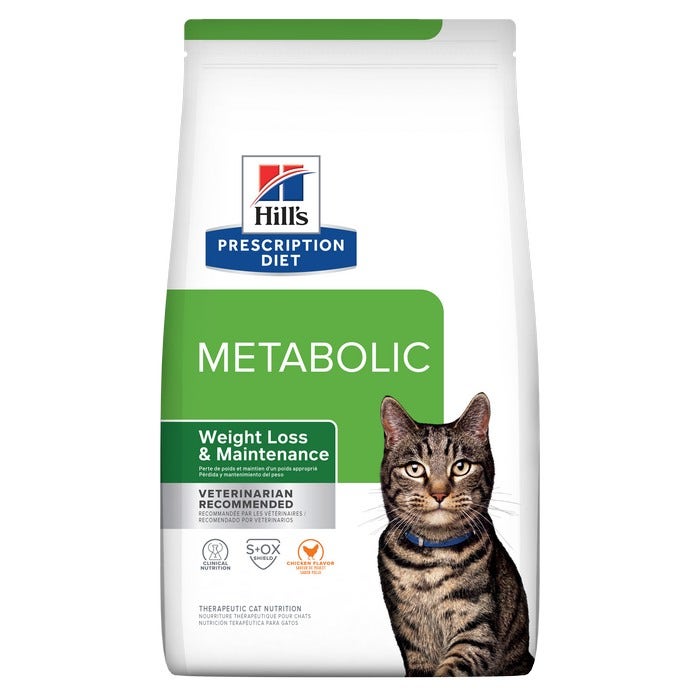
✓Feeding trials substantiate that this product meets AAFCO nutrient profiles (Adult)"Animal feeding tests using AAFCO procedures substantiate that Hill's Prescription Diet Metabolic Chicken Flavor Cat Food provides complete and balanced nutrition for maintenance of adult cats" (brand statement)
Protein38.6%AAFCO min 26% DM
Fat13.4%AAFCO min 9% DM
Fibre9.8%no AAFCO reference
3,398 kcal/kg≈ 1,422 kJ / 100g energy densityBrand states 3,398 kcal/kg
This manufacturer publishes its analysis on a dry-matter basis (with moisture removed), so the values above are shown on that basis and moisture is not stated. AAFCO minimums are also dry-matter figures, so they compare directly; the comparison is shown for context only. Consult your vet for diet decisions.
Brand transparency
Hill's · what the manufacturer discloses, not a rating
Part of Colgate-Palmolive (Hill's Pet Nutrition) · 3 brands on Pawdit
Recall historyon record2019: Included in excess Vitamin D canned dog food recall. Multiple products affected.
AS5812 accreditationAustralia's voluntary pet food manufacturing standardnot confirmed
PFIAA membershipPet Food Industry Association of Australiaconfirmed
Quality certificationsconfirmedAAFCO · FDA cGMP
Parent companydisclosedColgate-Palmolive (Hill's Pet Nutrition)
A factual disclosure checklist from public records and the brand's own statements. Items we haven't verified show as not confirmed: a data gap, not a judgment. Are you Hill's? Claim your brand to confirm or correct this record.
Customer reviews
4.6
98 reviews · aggregated from retailer listings across multiple sources
Where to buy
confirm prices and explore sizes on the retailer's site
● Contextual noteA digestible carbohydrate and protein source for most dogs. Commonly characterised as filler in consumer discussions, but veterinary nutrition research supports its nutritional value.Sources: AAFCO 2024 · NRC 2006
● Under research reviewA plant-derived insoluble fibre. Provides bulk but limited nutritional value. Acceptable in small amounts; when present as a primary fibre source (top 10 ingredients), it may indicate a high proportion of nutritionally inert filler.Sources: NRC 2006 Nutrient Requirements · Nutritional composition data
5Dried Tomato PomaceTomatoes▾
● Standard ingredientA fruit providing lycopene and vitamins.Sources: Nutritional composition data
6FlaxseedFlaxseed / flaxseed oil▾
● Contextual noteCats have negligible ability to convert plant-based ALA to the bioactive EPA and DHA forms. Flaxseed provides no meaningful omega-3 benefit for cats. Marine sources are required.Sources: Bauer 2011
7Dried Beet PulpBeet pulp▾
● Beneficial (supported)A well-studied moderately fermentable fibre source associated with stool quality benefits in dogs.Sources: NRC 2006 · Fahey et al. 1990
8Chicken Liver FlavorNamed organ meats▾
● Beneficial (well-established)Organ meat from a named animal species, with both the species and the organ identified. Published nutrition references describe named organ meats (e.g. chicken liver, beef heart) as nutrient-dense, naturally rich in vitamins A and B12, iron, copper, and folate. Where the label names only the organ (e.g. "liver"), the animal species is not identified.Sources: NRC 2006 · Nutritional composition data
▾
● Standard ingredientA naturally occurring organic acid used as a preservative or pH regulator.Sources: AAFCO ingredient definitions
12Potassium ChloridePotassium salts▾
● Standard ingredientA standard added potassium (mineral) supplement.Sources: NRC 2006
13Calcium SulfateCalcium salts▾
● Standard ingredientA standard added calcium (mineral) supplement.Sources: NRC 2006
14L-Lysine▾
● Standard ingredientAn essential amino acid added as a standard supplement.
15Choline Chloride▾
● Standard ingredientCholine chloride: a standard added nutrient for normal cell and nerve function.
16Carrots▾
● Standard ingredientA root vegetable providing beta-carotene and fibre.Sources: Nutritional composition data
17DL-Methionine▾
● Contextual noteAn essential amino acid commonly added to pet food. Also functions as a urinary acidifier (lowers urine pH). Veterinary sources note it should be used with caution in pets with kidney disease, pancreatic disease, or liver insufficiency. Not recommended for kittens.Sources: VCA Animal Hospitals · PetMD veterinary reference · NRC 2006
18vitamins (Vitamin E Supplement, L-Ascorbyl-2-Polyphosphate (source of Vitamin C) , Niacin Supplement, Thiamine Mononitrate, Calcium Pantothenate, Pyridoxine Hydrochloride, Vitamin A Supplement, Riboflavin Supplement, Biotin, Vitamin B12 Supplement, Folic Acid, Vitamin D3 Supplement)12 components▾
● Standard ingredientA generic term for a vitamin premix. Where the label lists the specific vitamins in brackets, each is shown and classified below; otherwise the individual vitamins are not disclosed.Sources: AAFCO ingredient definitions
The label breaks this entry into components, each classified on its own:
19TaurineTaurine (supplemental)▾
● Beneficial (well-established)Taurine is an essential amino acid for cats. Deficiency can cause serious health consequences including dilated cardiomyopathy, central retinal degeneration, and reproductive failure.Sources: Pion et al. 1987 · NRC 2006 · Freeman et al. 2018Position on the ingredient list suggests a small inclusion level.
20L-Carnitine▾
● Beneficial (emerging)L-carnitine is associated with fat metabolism support in some studies, particularly in weight management contexts.Sources: Gross et al. 2000Position on the ingredient list suggests a small inclusion level.
● Standard ingredientA generic term for a mineral premix. Where the label lists the specific mineral compounds in brackets, each is shown and classified below; otherwise the individual minerals are not disclosed. European-style labels declare added trace minerals as numbered additives with doses (e.g. "E4 (copper): 10 mg").Sources: AAFCO ingredient definitions
The label breaks this entry into components, each classified on its own:
22Mixed Tocopherols for freshnessMixed tocopherols (natural preservative)▾
● Beneficial (emerging)This product uses mixed tocopherols (natural vitamin E) as a preservative, which is an alternative to synthetic preservation systems.Sources: NRC 2006Position on the ingredient list suggests a small inclusion level.
23Natural FlavorsNatural flavours▾
● Contextual noteA broad AAFCO-defined category that may contain multiple unspecified compounds. Relevant for allergy-prone pets since potential allergens may not be individually listed.Sources: AAFCO 2024
24Beta-Carotene▾
● Beneficial (emerging)Cats cannot convert beta-carotene to vitamin A and must obtain preformed vitamin A from animal sources.Sources: Chew et al. 2000 (Journal of Nutrition)Position on the ingredient list suggests a small inclusion level.